

Is the graduate job dead?

If AI takes the junior jobs, who exactly is going to become senior?
There is a particular sort of newspaper headline that makes every parent of a school-age child stare into the middle distance. “Graduate job vacancies fall for fifth year in a row” is one of them. It has the reassuring rhythm of a weather forecast, except the weather is your child’s future and the umbrella is a degree certificate.
The latest figures suggest that graduate recruitment among the UK’s top employers has fallen by more than a quarter since 2022, with 2026 marking another annual decline. Recruitment is reportedly back around levels last seen in 2010. There are still more than 22,000 graduate vacancies expected among the Top 100 employers for 2027, so this is not quite the apocalypse. It is more the sort of apocalypse where there are still several thousand seats available, but everyone has been told to apply before Christmas and the queue is arranged by algorithm.
The obvious explanation is AI. Companies no longer need quite so many junior analysts, researchers, administrators and spreadsheet-operatives because software can summarise the documents, draft the first version and produce a graph with an axis that technically exists. The old entry-level bargain was simple: you did the tedious work, and in exchange someone gradually taught you how the business functioned. Now the tedious work is precisely the bit machines are becoming good at.
But “AI did it” may be doing rather too much work as an explanation. Employers are also cautious. The economy has been peculiar. Costs have risen. Business models are changing. Firms are trimming recruitment because they can, and because their shareholders appear to regard the existence of a junior employee as a personal affront. AI is not necessarily the cause of every missing vacancy. It may simply be the most fashionable justification available for a hiring freeze that would otherwise be described as “we are nervous and would prefer to wait”.
That distinction matters. If graduate recruitment is down because the economy is weak, it may recover. If it is down because firms have discovered that a subscription to a model can do the work of five analysts, then the problem is structural. And if it is a little bit of both, which is usually how reality behaves when invited to a conference, young people face a particularly awkward market.
The advice is already arriving. Learn to use AI. Build a portfolio. Become adaptable. Consider freelancing. Perhaps start a business. This is all sensible in moderation, but “start a business” is increasingly offered to graduates as though the country is short of apps, coffee shops and people willing to describe themselves as a founder on LinkedIn.
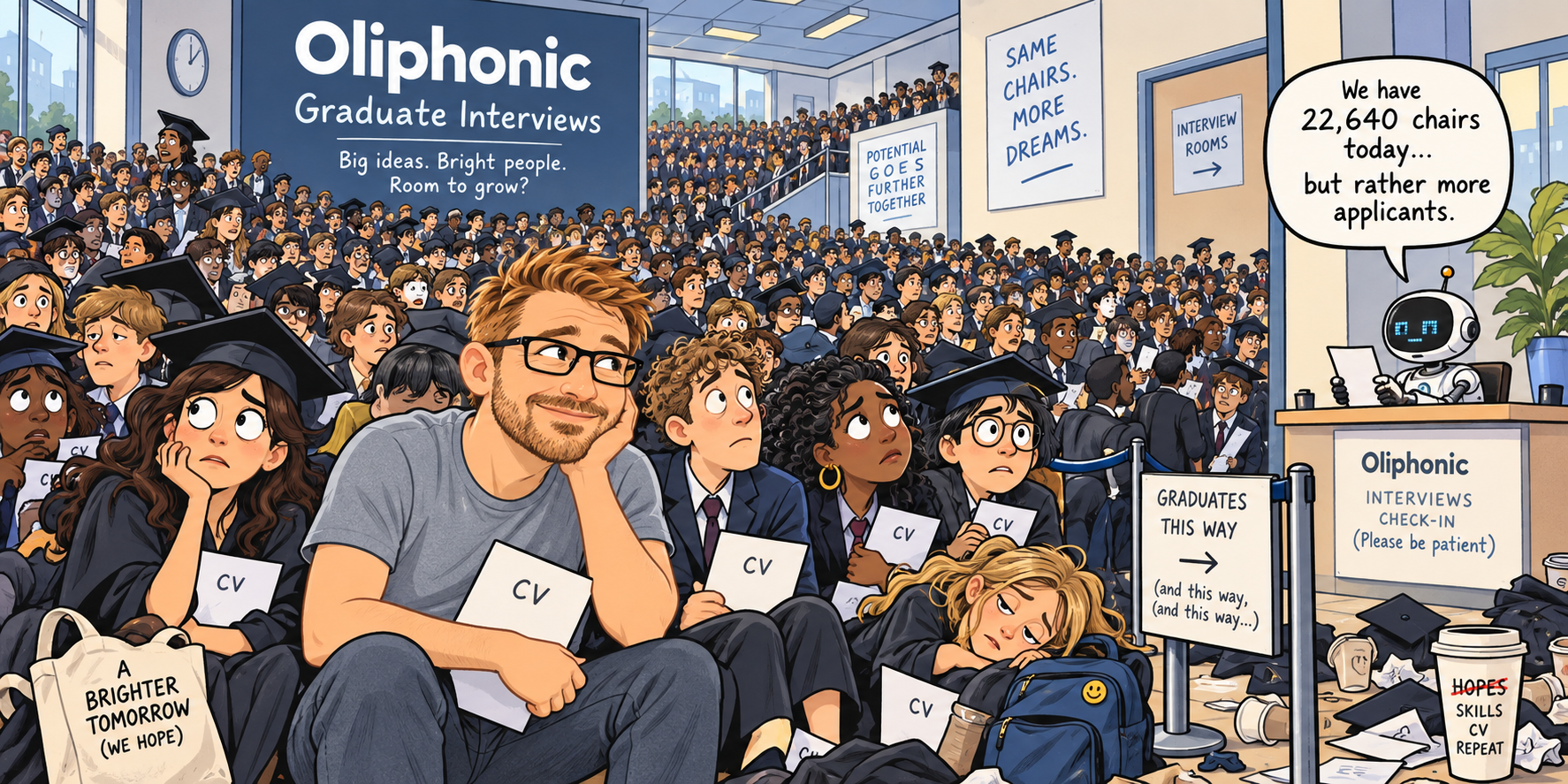
There is nothing wrong with entrepreneurship. Some graduates will build excellent companies. But it cannot be the universal escape route from a shortage of conventional jobs. A society cannot employ millions of people by telling them all to employ themselves. At some point somebody has to buy the product, and preferably not just the course explaining how to sell the product.
The regional picture makes this sharper. A graduate in one part of the country may face a wildly different market from someone with the same degree in another. A vacancy is not really available if it requires moving to London, paying London rent and discovering that the salary has remained at 2019 levels because “the opportunity is invaluable”. The graduate job market is not one market. It is a patchwork of industries, cities, commuting distances and family circumstances, held together by recruitment websites and mild despair.
There is also an uncomfortable question about what university is now for. The traditional promise was not merely “learn some things and receive a certificate”. It was a transition into adult work, with graduate schemes acting as a bridge between academic knowledge and professional judgement. If the bridge is narrowed, university may continue to produce educated people without providing a reliable route into the institutions that need them.
That would be a problem even if AI never eliminated a single job. Graduates are already competing for fewer roles, while employers can select from an enormous pool of applicants. A degree has become both more common and more expensive, which is an impressive trick if your aim is to make young people feel both overqualified and insufficiently experienced at the same time.
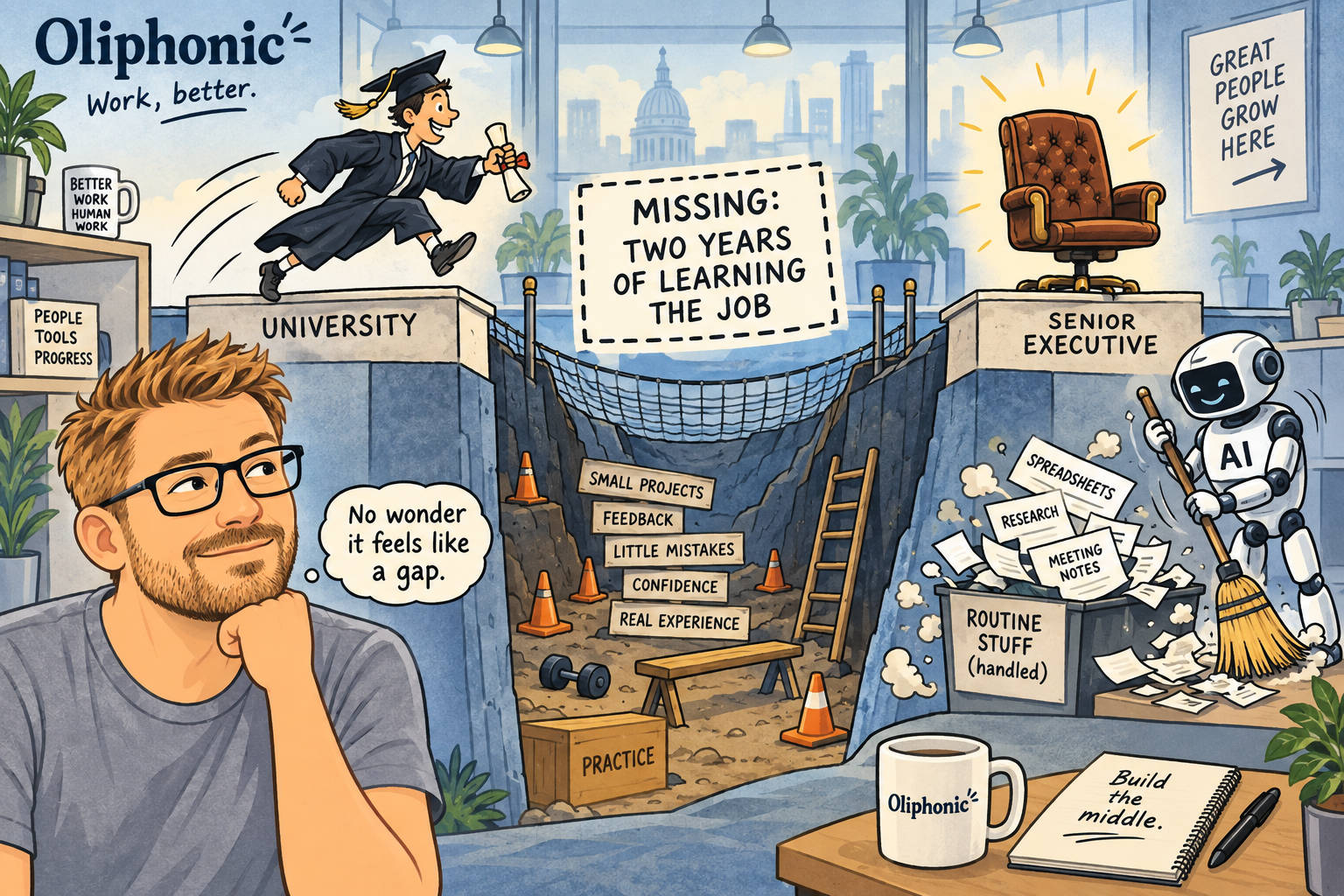
The deeper issue is the disappearance of the training ground. Junior work has always contained drudgery. My early professional life involved plenty of tasks that would not look impressive on a film about a young consultant. Copying information between documents, cleaning data, preparing meeting notes and producing the first version of something were not thrilling. They were also how I learned what good looked like, how mistakes propagated and which questions to ask before presenting a number to somebody with a budget.
If AI removes those tasks, that could be wonderful. Nobody should be required to spend three hours making a table align because an organisation has mistaken suffering for development. But the work has to be replaced with deliberate practice. Young people need opportunities to critique outputs, test assumptions, speak to clients, make decisions, receive feedback and occasionally be wrong in a recoverable way.
Otherwise we risk creating a strange missing middle: graduates are expected to supervise work they have never learned to do, while experienced professionals wonder why the newest member of the team cannot intuit a process that took them seven years to acquire.
This is the pipeline problem. If companies stop hiring and training junior people, who becomes the experienced workforce in ten or fifteen years? Perhaps AI will make everyone productive enough that we need fewer senior professionals too. Perhaps. But the confident version of that argument tends to skip over the small detail that judgement is not downloaded fully formed from a cloud endpoint. It is built through exposure, repetition, feedback and the occasional meeting in which someone says something so misguided that it permanently improves your internal quality-control system.
The graduate role may therefore be changing rather than simply dying. The smaller number of jobs that remain may demand more judgement from the beginning: using AI without being fooled by it, explaining recommendations, understanding customers and handling ambiguity. That sounds attractive, but it also risks turning entry-level recruitment into a search for finished professionals.
We may ask twenty-two-year-olds to arrive with experience, judgement, commercial awareness and the emotional resilience of a lighthouse keeper, then look surprised when they have mainly just completed university.
What should graduates do? Learn the tools, certainly. But also learn the underlying discipline. Someone who can use AI to analyse a problem but cannot tell whether the answer is nonsense is not AI-enabled; they are merely accompanied.
Build communication skills, domain knowledge and the ability to ask good questions. Seek environments where somebody will let you practise rather than merely produce. And be suspicious of any advice that treats a frightening structural change as a cheerful personal branding exercise.
Employers have responsibilities here too. If AI increases productivity, some of the dividend should fund better development, not just remove the people who would otherwise have learned the work. Universities need to be honest about the transition they offer. Government needs to think beyond the number of degrees awarded and ask how people move from education into useful responsibility.
“The market will sort it out” is not a plan; it is the economic equivalent of leaving a note on the fridge.
So, is the graduate job dead? No. But the old graduate job — the reasonably accessible first rung on a long ladder — is being dismantled faster than we have designed its replacement.
And if AI removes the rungs at the bottom, who exactly is going to climb high enough to replace us?