

Automating with AI… Where’s the End of the Road?

There is a particular kind of technological progress that feels less like a revolution and more like a tide coming in.
You notice it first by the things you no longer have to do.
A few years ago, if you wanted a website, an app or a digital product, you needed somebody who could write code. Then, gradually, we taught AI to write some of that code for us. You described what you wanted; it produced a function, a component, perhaps even an entire prototype. The human still held the pen, but the pen had become strangely optional.
That was impressive. It was also only the beginning.
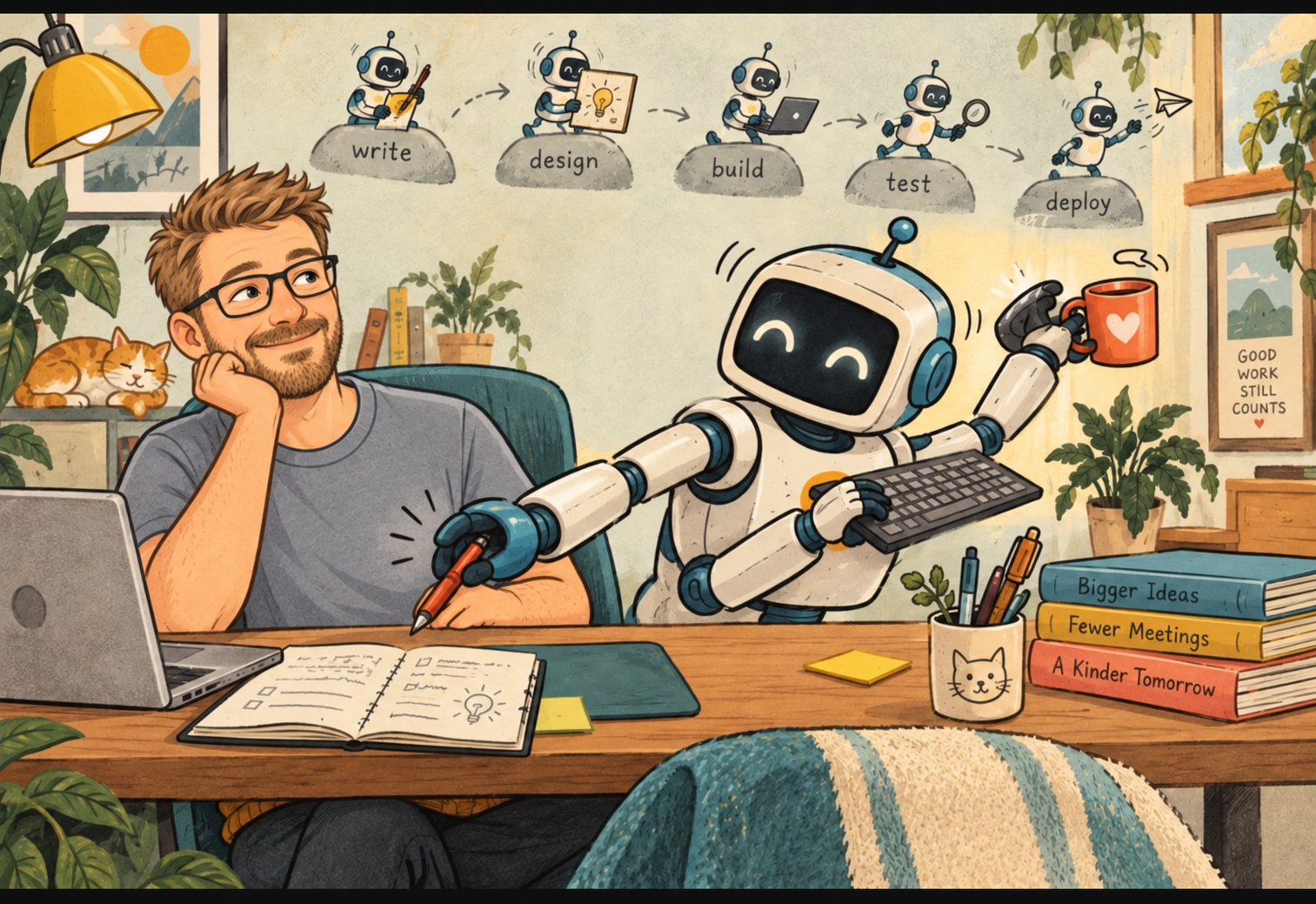
The next step was not simply asking AI to write code, but asking it to do something with the code. Run the tests. Fix the errors. Commit the changes. Open the pull request. Deploy the thing. Suddenly, the human role was no longer “builder” so much as “supervisor of a very fast junior developer who never sleeps and is oddly confident about everything.”
Then the boundary moved again. AI stopped being just a code generator and started behaving more like a little project team. It could interpret a broad brief, decide which features were needed, work out how they fitted together, make choices about the user journey and keep track of the wider ecosystem around the product.
At that point, the question changed. It was no longer: “Can AI write this piece of code?” It became: “Can AI understand what we are trying to make?”
And now the machines are designing the thing too.
They can sketch the interface, suggest the colour palette, generate the illustrations, write the copy and produce five alternative logos before a human has finished making tea. They can take a vague instruction — “make this feel simpler, friendlier and more premium” — and turn it into a set of visual decisions. Not always good decisions, admittedly. But increasingly plausible ones.
This is where the idea of “automation” starts to feel slightly inadequate. Automation sounds like replacing one repetitive task. What we are seeing is closer to abstraction: the gradual lifting-away of the individual human steps that used to make up a piece of work.
First, AI writes the code. Then it controls the machinery that publishes the code. Then it becomes an agent that understands the product around the code. Then it designs the interface. Then it tests the experience. The hand-offs between human specialists begin to disappear, one by one.
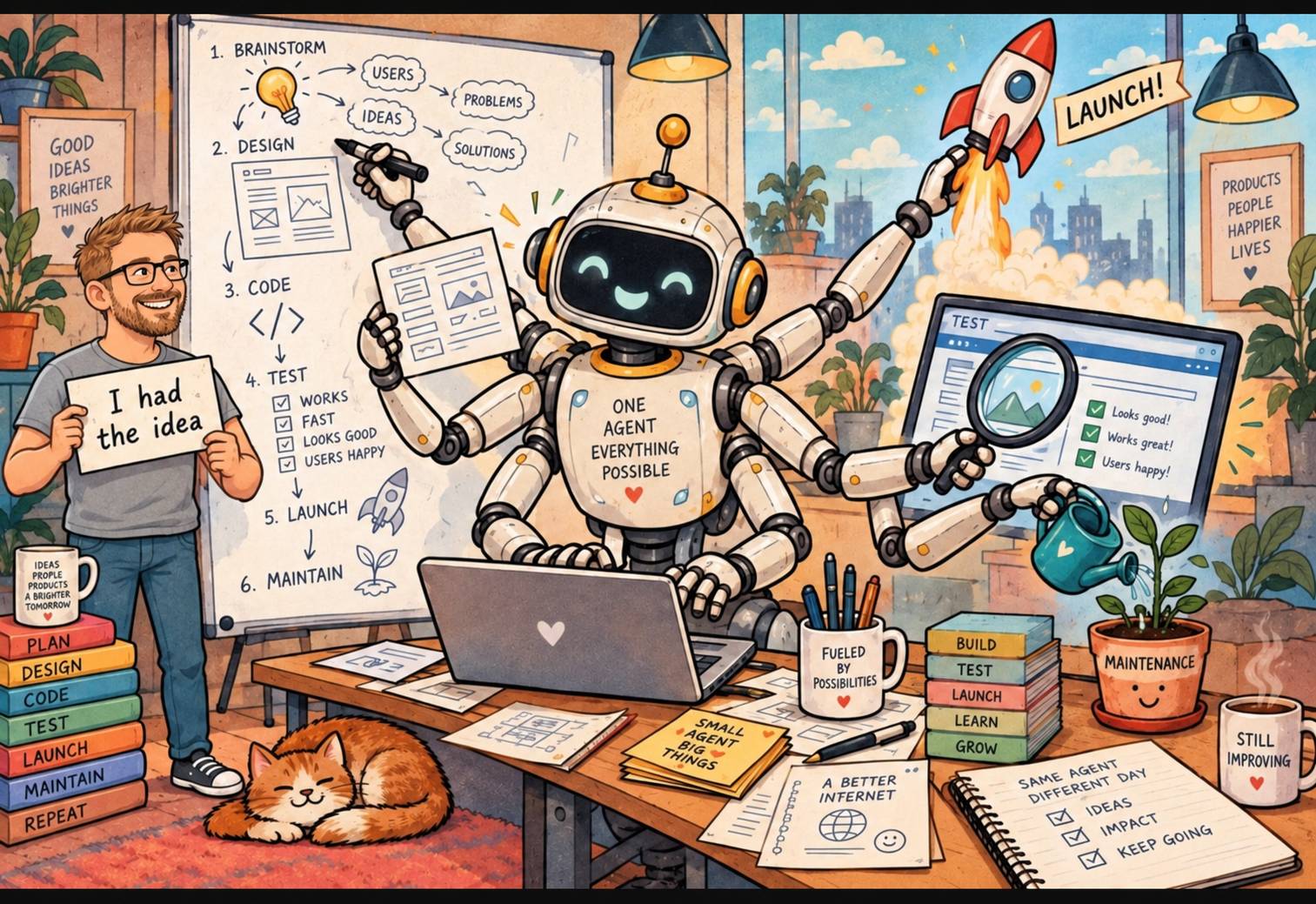
So what happens when the hand-offs disappear entirely?
Imagine starting with nothing more than a sentence: “I want to build a tool that helps parents organise the chaos of family life.” From there, an AI system could interrogate the idea, identify the audience, research competing products, propose the features, design the brand, build the application, test it with simulated users, deploy it to the cloud, write the launch campaign, monitor usage and suggest improvements.
The human might approve the direction. They might answer questions. They might say, “No, that button is ugly,” or “Actually, parents do not want a dashboard that looks like an aircraft cockpit.” But the bulk of the making could happen elsewhere.
Elsewhere meaning where? Inside a model? Inside a swarm of models? Inside a software environment that has quietly become less like a tool and more like a small digital company?
This is the part that feels both thrilling and faintly unsettling. We tend to imagine automation as a machine taking over a job. But perhaps the more important change is that AI takes over the connections between jobs.
Historically, making something involved a sequence of human judgements. An idea became a brief. The brief became a design. The design became software. The software was tested, launched, explained, sold, supported and improved. Each transition required communication, translation and interpretation. Each one created friction. Each one created a place for a human being to add value.
AI is steadily flattening those transitions.
That could be wonderful. If the cost of turning an idea into a useful product falls dramatically, more people may be able to create things. A teacher with a good lesson idea might build an educational tool. A nurse might prototype a better way of organising a clinic. A parent might make the family app they always wished existed. The distance between imagination and reality could shrink.
But what happens to the people whose expertise used to live inside that distance?
And what happens to our sense of achievement when the thing we imagined is designed, built and launched mostly by something else? Is having the idea enough? Is choosing between the options enough? Does authorship survive when the author is mostly approving work rather than performing it?
Perhaps humans will move upwards, as we are often told. We will focus on judgement, taste, empathy, strategy and meaning. We will decide what is worth making and why. AI will handle the execution.
That sounds plausible. It may even be broadly right. But “moving upwards” can sometimes be a polite way of saying that the lower layers of work have disappeared. And if AI keeps moving upwards too, what happens when it can generate the strategy, evaluate the options and propose the meaning as well?
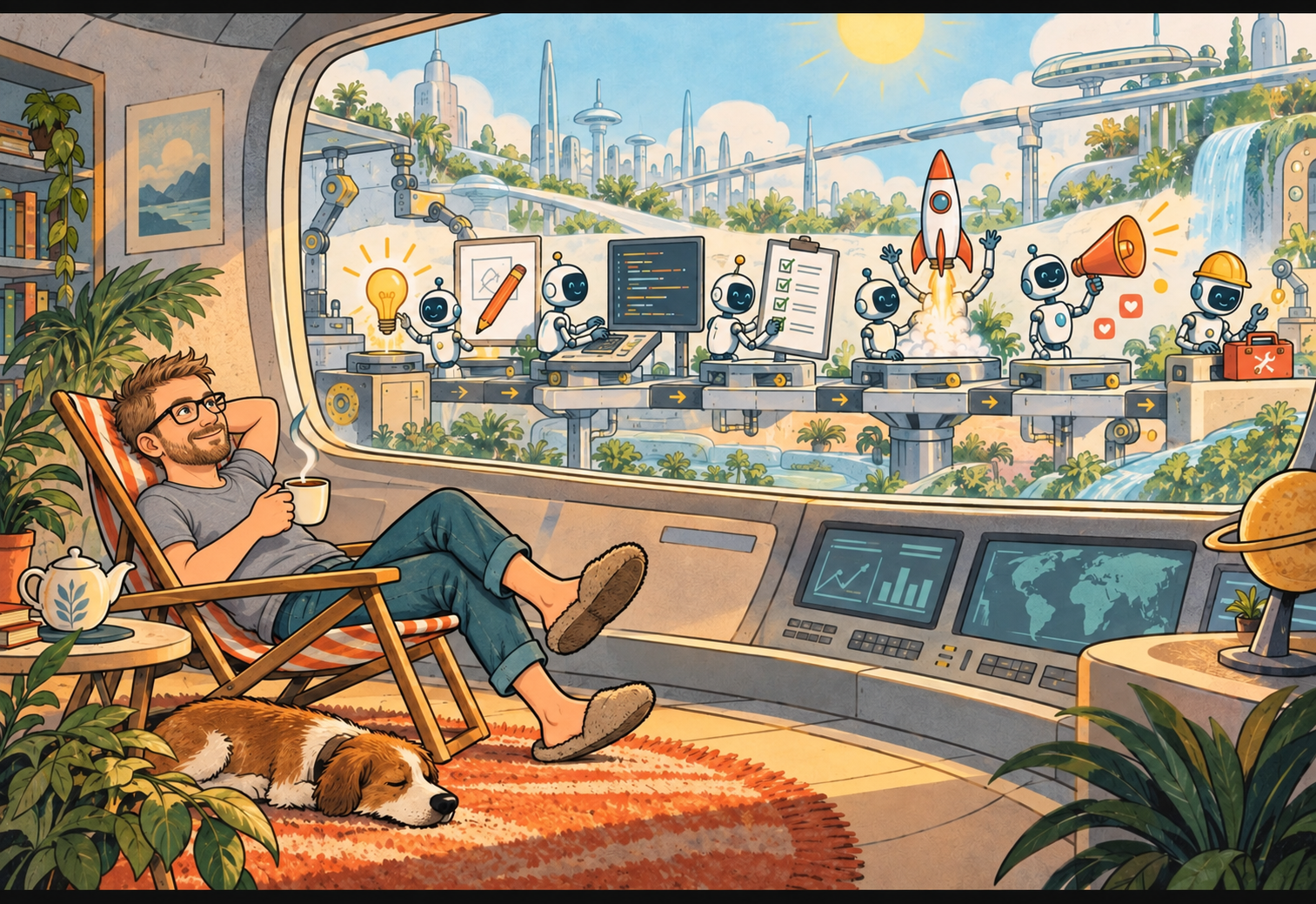
Are we heading towards a world where humans become directors of an enormous, tireless creative machine? Or are we heading somewhere stranger: a world in which the machine does all the visible work, while humans are left with the responsibility for deciding whether any of it matters?
Maybe the end of the road is not a robot dictator or a dramatic sci-fi apocalypse. Maybe it is much quieter.
Maybe one day you will describe a business, a film, a product or a movement in a paragraph, press a button, and watch the whole thing come into existence. The AI will ideate it, design it, build it, test it, deploy it, market it, maintain it and evolve it.
And you will sit back, cup of tea in hand, wondering whether you have created something — or merely asked for it.
Where, then, is the end of the road?
I suspect the honest answer is that we are still walking towards it. The strange thing is that, step by step, AI is not just automating what humans do. It is quietly redefining what counts as “doing” in the first place.