

AI is making us faster. Are we actually getting any better?

We can now produce reports, analysis, emails and PowerPoint decks at increasingly ridiculous speed. The awkward question is whether all that extra output represents more value — or simply more stuff.
There is something slightly intoxicating about watching AI do work that used to take ages. A market scan in three minutes. A first-pass strategy deck before the coffee has gone cold. A meeting summary before half the attendees have worked out what the meeting was about. An options paper, a risk log, a comms draft, a stakeholder map and twelve cheerful bullet points explaining why all of this is “transformational”.
It feels like progress because it is fast. And speed is visible. You can measure it. You can compare it. You can put it in a business case. “This used to take two days and now it takes twenty minutes” is the sort of sentence that makes people nod seriously in steering committees. Which is fair enough. Saving time is useful.
But lately I have started wondering whether we are quietly confusing faster production with better work. Because these are not the same thing. The AI can make me ten times faster at producing something that was not particularly useful in the first place. That is not transformation. That is a very efficient leaf blower.
We have industrialised the first draft
AI is astonishingly good at creating the first 60–80 per cent of knowledge work. Research summaries. Initial analysis. Document structures. Draft recommendations. Meeting outputs. Presentations. Emails. Code. Workshop agendas. Competitive comparisons.
This is genuinely valuable. The problem is that organisations already produced too much of this stuff before AI arrived. We were not exactly suffering from a global shortage of PowerPoint. Now we have machines capable of creating plausible professional output on demand, which means the marginal cost of producing yet another report is approaching “why not?”
And once the cost of something collapses, we tend to make more of it. More analysis. More options. More slides. More documentation. More emails summarising the meeting about the document that summarised the previous meeting. The great productivity revolution may therefore begin with everybody receiving considerably more material to ignore.
This is not entirely the machine’s fault. AI is doing precisely what we asked it to do. The real question is whether we are asking it to optimise the right thing.
Output is not the same as value
Most organisations still measure work using proxies. Number of deliverables. Tasks completed. Tickets closed. Documents produced. Hours saved. Milestones hit. These are understandable because they are easy to count.
But nobody hires a consultant because they desperately need 84 slides. They need a decision. Nobody wants a market analysis because the world has been crying out for another two-by-two. They want to understand where to invest. Nobody implements AI because they have an emotional attachment to token throughput. They want something meaningful to improve: revenue, cost, customer experience, speed, quality, risk, employee productivity.
The artefact is not the outcome. This sounds painfully obvious until you look at how much corporate life is organised around producing artefacts. AI makes this distinction more important because it can manufacture the appearance of progress at extraordinary speed.
A beautiful report appears. The headings are sensible. The recommendations sound plausible. The grammar is immaculate. There may even be a tasteful gradient. We feel productive because something now exists that did not exist twenty seconds ago. Whether it is actually right is a separate administrative matter.
Faster can make bad decisions worse
There is also a more uncomfortable possibility. Speed does not just accelerate good work. It accelerates bad work too. If the premise is wrong, AI can help me explore the wrong premise faster. If the data is poor, it can generate a very articulate interpretation of poor data. If nobody understands the real business problem, it can create thirty pages explaining our confusion in an impressively structured way.
This is where judgement becomes more important, not less. When production was expensive, there was at least some friction before creating something substantial. Someone had to spend hours researching it. Someone had to write it. Someone had to build the slides. That friction was wasteful in many cases, but it also acted as a crude filter.
Now the filter has gone. We can explore twelve strategic options before lunch. Brilliant. Should we?
The scarce resource is moving
For years, organisations behaved as if the scarce resource was production capacity. How quickly can the team analyse this? How many people do we need? How long will the deck take?
AI is rapidly reducing that constraint. The scarce resource is becoming something else: attention. And judgement. And the ability to decide what matters.
If AI can produce ten analyses in the time it previously took to produce one, somebody still has to read the ten analyses. Or, more realistically, skim three, pretend to read four and ask for a one-page summary of all ten. Then somebody has to make a decision. That part has not become ten times easier.
Perhaps this is the strange inversion of AI productivity. The cheaper answers become, the more valuable good questions become.
What humans still do
This is also why I remain unconvinced by the neat little story that AI simply “replaces tasks”. Some tasks, absolutely. But the interesting work usually sits around the edges.
What problem are we actually solving? Which constraints matter? Which data should we trust? What is politically possible? What will customers tolerate? What does the regulator care about? What will quietly fail because two departments hate each other? Which technically elegant option will never get funded?
AI can help with all of these. But it cannot magically remove the messy reality that makes them difficult.
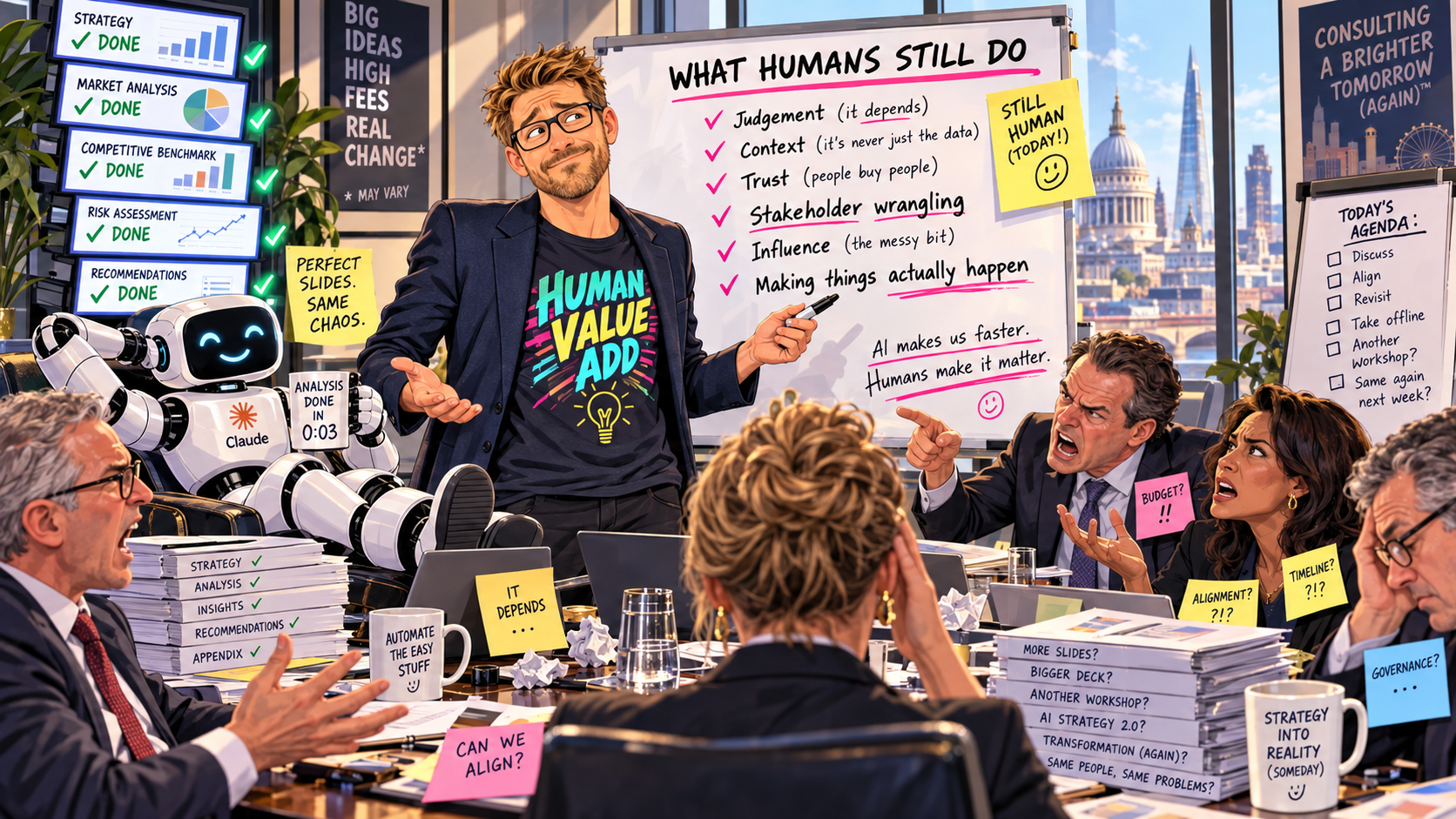
In my own work, the hardest part is rarely generating possibilities. It is narrowing them. It is understanding why the apparently obvious answer is not obvious inside this particular organisation. It is getting five groups of intelligent people, each with entirely rational incentives, to agree to do the same thing.
You cannot benchmark your way out of that. Occasionally you need to sit in a room while somebody says “yes, but…” for forty-five minutes. Civilisation remains stubbornly human.
So what should we optimise?
Perhaps the useful productivity metric is not “how much faster did we produce the thing?” Perhaps it is: How quickly did we reach a good outcome?
That is much harder to measure. Which is probably why we do not. But it would change how we think about AI.
A model that generates a report ten times faster is helpful. A system that helps us avoid producing the report at all because it identifies the actual decision required is much more interesting. A tool that creates fifty recommendations is impressive. A tool that helps us choose the right three is valuable.
The distinction is subtle, but economically enormous.
I still want the speed
None of this is an argument for slowing down. I have no nostalgic attachment to spending six hours manually formatting slides because it builds character. If a machine can remove administrative sludge from my day, excellent. Let it have it. I would happily outsource several categories of work to an unusually competent toaster.
But speed should buy us something. It should create room for thought. More time talking to customers. More time challenging assumptions. More time understanding the system we are changing. More time making the recommendation better.
Otherwise we risk filling every minute we save with more output. Which is a very human thing to do.
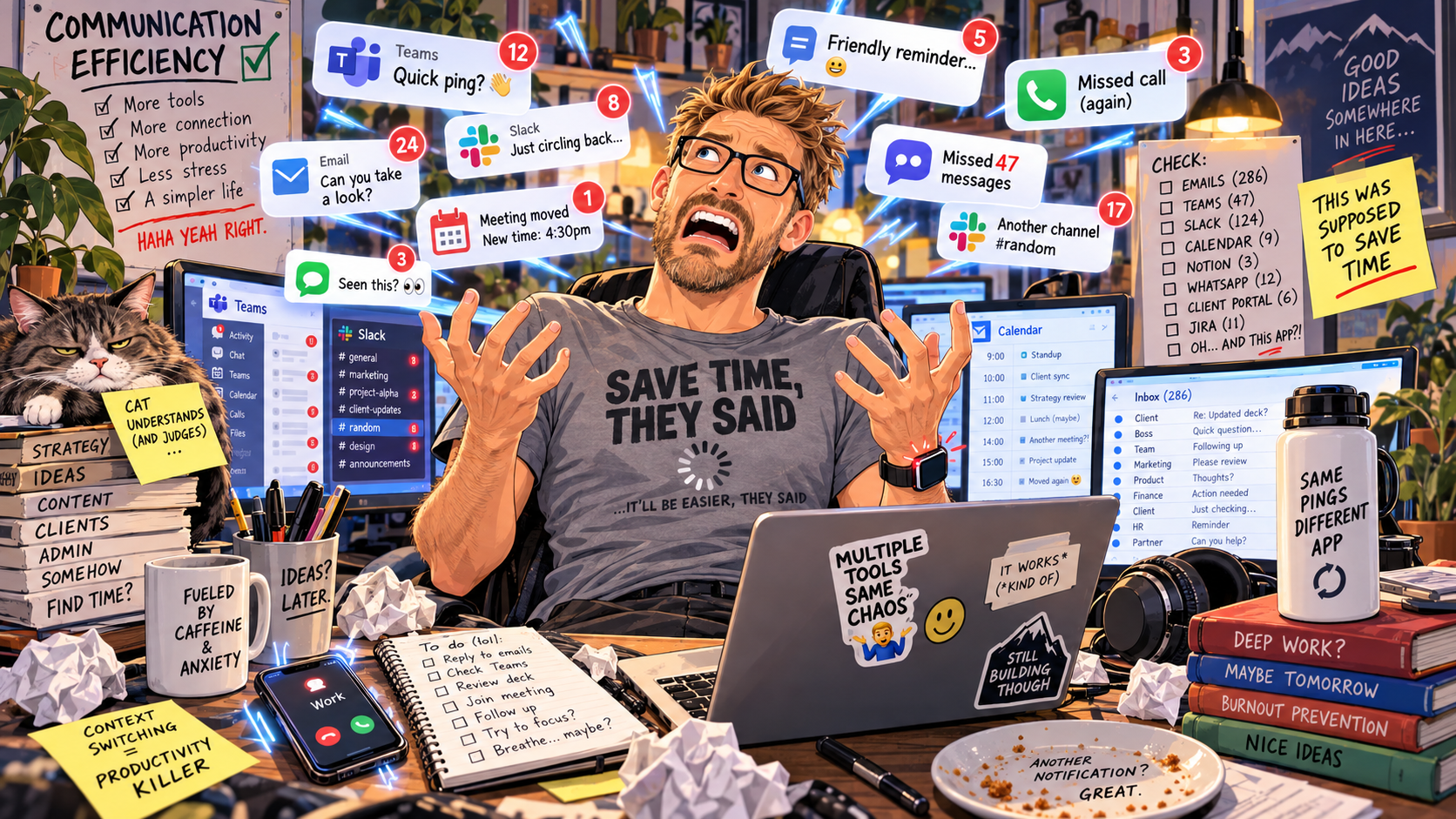
We invented email to make communication faster and somehow ended up with 187 unread emails. We invented collaboration tools so teams could collaborate more efficiently and created seventeen places to check whether someone has asked us a question. There is no law saying AI productivity gains must automatically turn into better work.
We have to choose that.
Perhaps the real test of AI at work is not whether it helps us do more. It is whether, after doing less of the boring stuff, we actually use the time to do something better.
Otherwise we may simply become the most productive generation in history at producing things nobody needed.
And we will have done it very, very quickly.